
Written by: Paul Foster, Founder, CEO, OnePlan
Key Takeaways
- The Protect Duty (Martyn’s Law) requires UK local government events expecting 200+ attendees to apply proportionate terrorism protection procedures, with enhanced obligations at higher capacities.
- Event organizers must determine their tier, complete terrorism risk assessments, develop evacuation, invacuation, and lockdown procedures, train staff, and keep clear records.
- Capacity is calculated at peak attendance, including staff, and qualifying events with controlled entry fall under the enhanced tier with extra documentation and leadership duties.
- Free training resources like ACT Awareness and SCaN help staff recognize threats, while tools like OnePlan support accurate to-scale site planning, crowd capacity calculations, and exportable compliance documentation.
- Digital planning tools such as OnePlan can streamline Protect Duty documentation, site planning, and collaboration with partners.
What Is The Protect Duty (Martyn's Law)?
The Protect Duty, commonly known as Martyn's Law, is UK legislation that requires those responsible for public venues and events to take proportionate steps to protect the public from terrorist attacks. Named after Martyn Hett, a victim of the 2017 Manchester Arena attack, the Terrorism (Protection of Premises) Act 2025 received Royal Assent on 3 April 2025.
The law aims to improve security preparedness across the UK by ensuring that venues and events have appropriate procedures and measures in place. For local government, this covers council-run events such as town festivals, Christmas markets, firework displays, and street fairs when they meet capacity thresholds.
The implementation period runs at least 24 months from Royal Assent, and the law is expected to come into force in spring 2027, subject to regulations. The Security Industry Authority (SIA) will act as the regulator, with powers to inspect, issue compliance notices, and impose penalties for non-compliance. The Home Office published statutory guidance in April 2026 to help organizations prepare.
Local Government Events In Scope
Local government bodies such as councils, parks and recreation departments, and town and parish councils are responsible persons when they organize or license public events. This includes events you run directly and those you enable through licensing or land provision.
Examples of in-scope events include:
- Town and community festivals
- Christmas markets and light switch-ons
- Firework displays
- Street fairs and parades
- Outdoor concerts and cinema screenings
- Agricultural shows and county fairs
Even if you outsource event delivery to a contractor, your council may still have duties as the landowner or licensor. The responsible person is determined by who controls the premises, not who owns it. When your council controls the premises for the event's purpose, you carry the legal responsibility and remain accountable even when you delegate tasks.
Standard Vs. Enhanced Tier For Premises And Events
The Protect Duty uses a tiered system based on the maximum number of people reasonably expected to be present at any one time, including staff. Knowing which tier applies to your premises or event guides your next actions.
| Tier | Capacity Threshold | Key Requirements |
|---|---|---|
| Standard | 200–799 people | Public protection procedures (evacuation, invacuation, lockdown, communication); staff awareness training |
| Enhanced | 800+ people | All standard requirements plus: documented terrorism risk assessment; public protection measures; designated senior individual; compliance document for SIA |
For premises like community halls or leisure centers that host events, the standard tier applies at the thresholds shown in the table. When your council-run event at that venue expects numbers at the enhanced threshold with controlled entry, the event itself triggers enhanced tier requirements.
Capacity should be assessed against peak use rather than an average day, so occasional higher-attendance events can bring premises into scope. Use your busiest moment and include staff, performers, vendors, and attendees.
Responsible Persons And Core Duties
Responsible persons for local government events carry specific legal duties under the Protect Duty. Your key duties include:
- Completing a terrorism risk assessment appropriate to your tier
- Putting proportionate public protection procedures and measures in place
- Ensuring staff and volunteers are trained and aware of procedures
- Recording your risk assessment, procedures, and measures
- Designating a senior individual for compliance at enhanced tier
- Coordinating with other responsible persons where multiple entities share responsibility
The concept of "reasonably practicable" sits at the heart of the law. It means weighing what can be done to achieve public protection objectives against the cost, time, and difficulty of implementation. The Home Office guidance highlights proportionate, sensible measures rather than specialist services or expensive equipment.
How To Conduct A Terrorism Risk Assessment For Your Event
A terrorism risk assessment focuses on the threat of terrorist attacks and your event's vulnerability to them. It complements your standard health and safety assessment by concentrating on deliberate attack scenarios.
Your assessment should consider:
- Site-specific threats and the event's attractiveness as a target
- Physical vulnerabilities such as entry points, queueing areas, crowd density, and vehicle access
- Attack methodologies: vehicle-as-weapon, marauding attacks, explosives, and layered attacks
- Existing measures and gaps in your current security posture
- The immediate vicinity, including nearby public gathering spaces
Walk the site with your team and use a to-scale map to identify vulnerable areas. Mark entry and exit points, crowd gathering zones, vehicle access routes, and potential hiding spots. Map likely crowd flows and note where bottlenecks might occur.
OnePlan's crowd capacity calculator helps you determine safe standing densities for different areas of your event site. Draw a crowd area, select your density setting, and instantly see how many people that space can safely hold. This data strengthens your risk assessment and shows clear decision-making. For estimating ingress and egress flow, OnePlan also offers free arrival and exit calculators to help you model queue lengths and exit capacity.
For enhanced tier events, consult your local police Counter Terrorism Security Adviser (CTSA) and engage your Safety Advisory Group (SAG). These partners provide expertise and help validate your approach.
Step-By-Step Compliance Plan For Your Event
Step 1: Determine Your Tier
Start by calculating your event's maximum expected capacity at peak time, including everyone present. Refer to the thresholds in the tier table above when deciding whether standard or enhanced duties apply. Record your capacity calculation and the reasoning behind it.
Step 2: Complete Your Terrorism Risk Assessment
Use your capacity figures and site layout to complete a terrorism risk assessment for the event. Walk your event site and identify potential vulnerabilities such as crowded areas, entry and exit points, vehicle access routes, queueing locations, and nearby public spaces. Consider different attack methodologies: vehicle-borne attacks, marauding attacks, and explosives. For enhanced tier events, document this assessment so it is ready for SIA review.
Step 3: Develop Public Protection Procedures
Create clear procedures for evacuation, invacuation, lockdown, and communication. Keep them simple, practical, and easy for staff to follow. At standard tier, these procedures and staff awareness form your main obligation. At enhanced tier, you also need physical and procedural measures that reflect your risk assessment.
Step 4: Plan Your Event Site To Scale
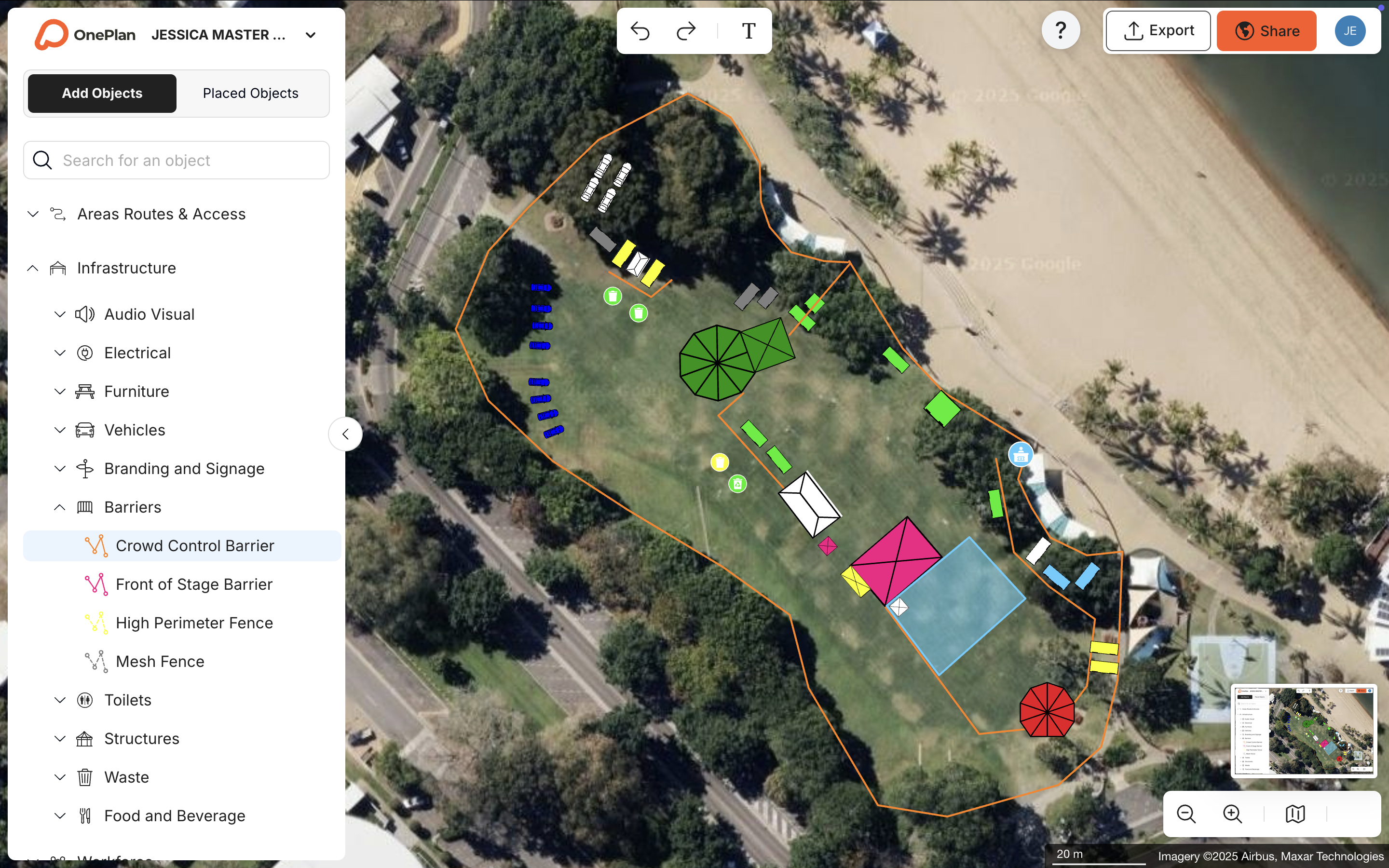
Prepare an accurate, to-scale site plan showing all security measures, crowd areas, entry and exit points, and emergency routes. This plan supports your risk assessment and helps you test scenarios before build. OnePlan makes this step straightforward: you can drag and drop barriers, fencing, CCTV positions, and staff deployment onto a live satellite map, so everything fits and works together before you place any orders.
Step 5: Train Your Staff And Volunteers
Make sure all staff and volunteers understand security procedures, how to spot suspicious behavior, and how to respond in an emergency. Free resources like the refreshed ACT Awareness e-learning on ProtectUK and SCaN training from NPSA provide strong foundations. Record all training completed.
Step 6: Document Everything
Keep records of your risk assessment, security plan, training logs, and procedural reviews. For enhanced tier events, prepare your compliance document for SIA submission. Clear documentation shows your "reasonably practicable" approach.
Step 7: Review And Update Regularly
Review your plan whenever the event changes, such as new vendors, different layouts, or increased capacity. Schedule annual reviews and post-event debriefs to capture lessons learned and update your documentation.
Staff Training And Public Awareness Requirements
Recommended training resources include:
- ACT Awareness e-learning: A free, refreshed course from Counter Terrorism Policing, available on ProtectUK. It suits all staff and volunteers and covers identifying suspicious activity and responding to threats.
- SCaN (See, Check, and Notify): Free training from NPSA focusing on spotting hostile reconnaissance and suspicious behavior. It works well for customer-facing staff and security teams.
- Event-specific briefings: Before each event, brief your team on your specific procedures, site layout, emergency routes, and communication protocols.
The Home Office does not prescribe a fixed refresher interval. Aim to maintain competence by scheduling refreshers annually or whenever procedures change. Record all training, including dates and attendees.
For enhanced tier events, appoint a designated senior individual responsible for compliance oversight. This person checks that procedures are implemented, training remains current, and documentation stays complete.
How To Document And Submit Compliance Evidence
Good documentation shows your "reasonably practicable" approach and provides evidence if the SIA inspects your event.
Maintain these records:
- Terrorism risk assessment with identified threats and vulnerabilities
- Public protection procedures covering evacuation, invacuation, lockdown, and communication
- Public protection measures implemented for enhanced tier events
- Staff training logs with dates and completion certificates
- Capacity calculations and tier determination reasoning
- Review and update schedule
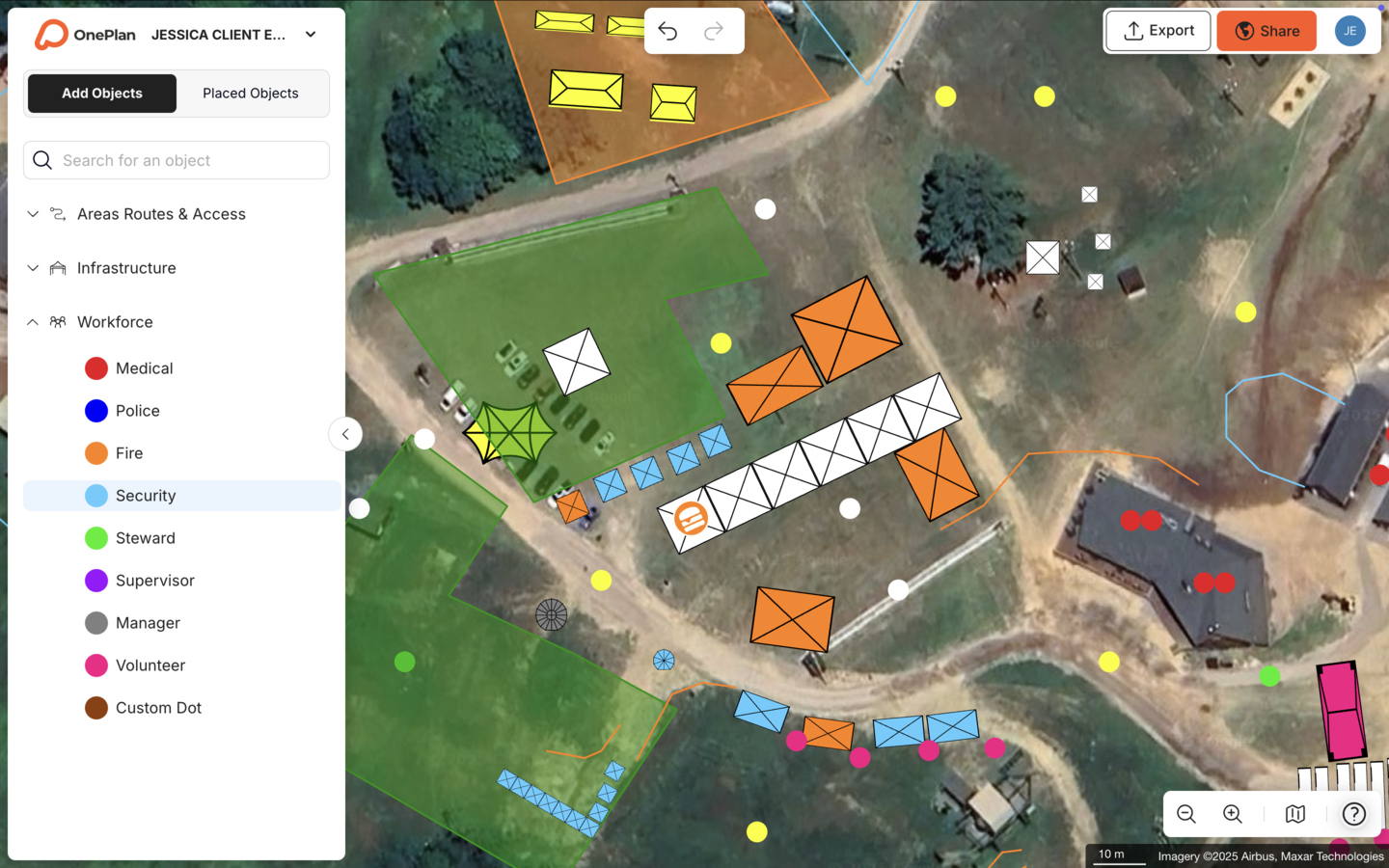
OnePlan helps you maintain organized, professional documentation. Export high-resolution site plans showing security measures, crowd areas, and emergency routes. Generate Bill of Quantities reports listing barriers, fencing, and other security infrastructure. Share live plans with your SAG, police, and other stakeholders so everyone works from the same current version.
How OnePlan Supports Protect Duty Compliance
OnePlan provides a visual, to-scale way to plan event sites and supports your Protect Duty compliance work. Key features for compliant event planning include:
- To-scale site planning: Create accurate maps of your event site on live satellite imagery. Place barriers, fencing, stages, and crowd areas that stay correctly scaled as you zoom.
- Crowd capacity calculator: Outline any area and instantly see its safe standing capacity based on a selectable density setting. Make clear, defensible capacity decisions.
- Traffic and access planning: Plan vehicle access, road closures, and pedestrian flow to reduce hostile vehicle risks and manage ingress and egress safely.
- Bill of Quantities: Automatically generate lists of barriers, fencing, and other security infrastructure needed. Draw a line of crowd barriers and see exactly how many segments to order.
- Real-time collaboration: Share your plan with police, fire, SAG members, and other stakeholders on a single live plan. This approach removes version control problems.
- Export for documentation: Produce high-resolution maps and reports for permits, SAG meetings, and compliance records.
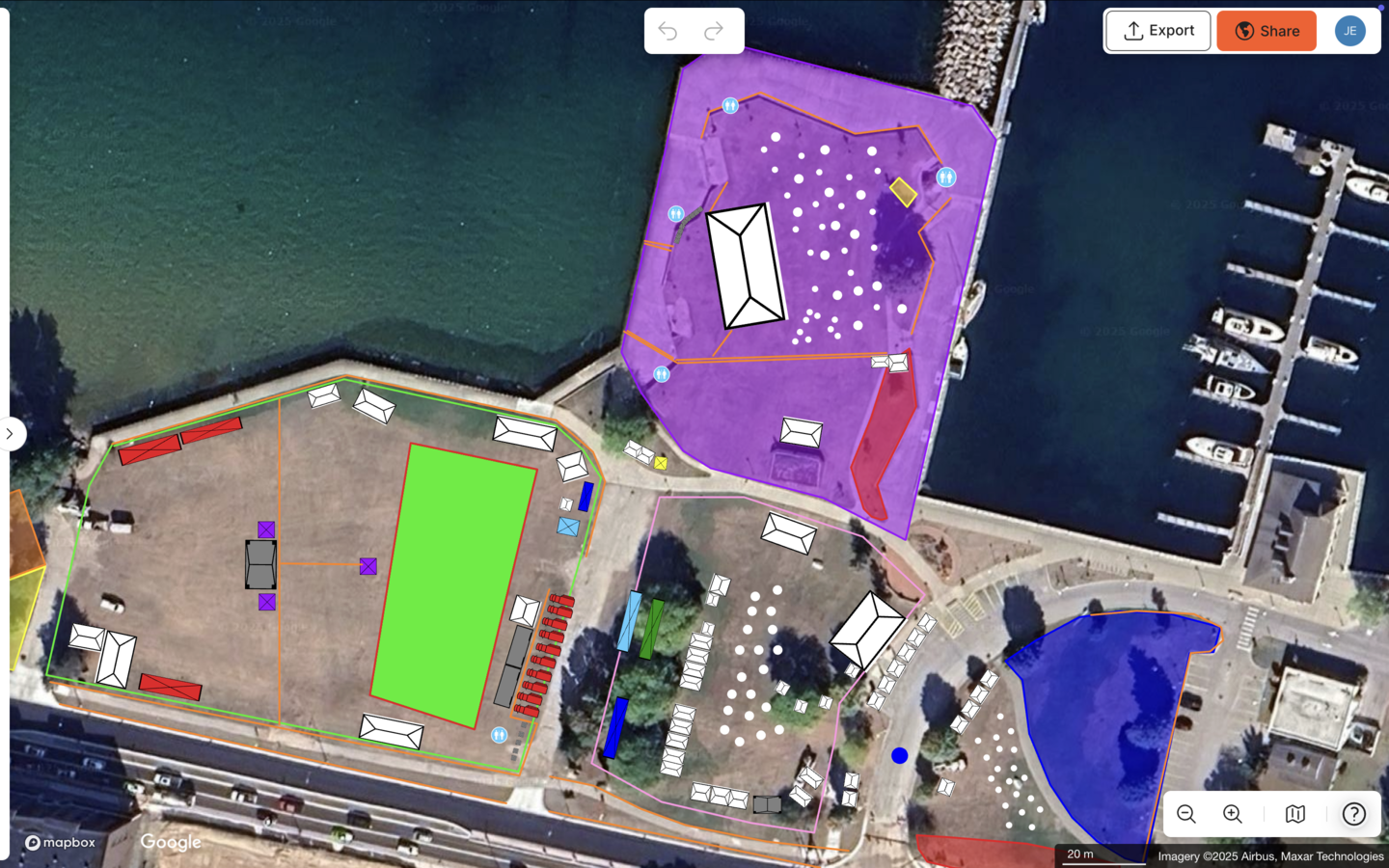
Local government teams across the UK and beyond use OnePlan to plan safer events. For example, Eagle Mountain City cut planning time by 70%, from 8–10 hours to a few hours per event. Their Events Manager explained the impact: "Gone are the days of creating separate layouts for fire, police, facilities, and other departments. Now I can create a single, all-encompassing layout."
Common Challenges And How To Address Them
Determining capacity accurately: One of the most common challenges involves calculating capacity at peak time. Use your event's maximum expected attendance, including staff, and document your calculation methodology. OnePlan's crowd capacity calculator helps you check that your planned areas can safely accommodate your expected numbers.
Coordinating multiple departments: Another frequent issue involves aligning different teams. Events, public works, police, fire, and parks teams often work from separate plans. OnePlan provides a single source of truth where everyone collaborates on one live plan, which reduces duplicated work and version confusion.
Keeping plans up to date: Event plans change regularly as vendors, layouts, and capacities shift. OnePlan's real-time collaboration means changes are visible instantly, and stakeholders always see the latest version.
Ensuring staff training is completed: Many councils struggle to track training across large teams. Track training completion systematically, use free resources like ACT Awareness and SCaN, and maintain clear records. Schedule refreshers annually or when procedures change.
Your Next Steps Toward Confident Compliance
Protect Duty compliance can sit comfortably within your existing event planning process. By following this step-by-step guide, you can build security preparedness into your workflows, create accurate and defensible site plans, and show your "reasonably practicable" approach to public protection.
Your next steps are:
- Identify which of your events fall within Protect Duty scope
- Complete terrorism risk assessments for in-scope events
- Develop public protection procedures and train your staff
- Create to-scale site plans showing your security measures
- Document everything and prepare for potential SIA inspection
Frequently Asked Questions
What Is The Protect Duty For Local Government Events?
The Protect Duty, also known as Martyn's Law, is UK legislation requiring those responsible for public venues and events to take proportionate steps to protect the public from terrorist attacks. As explained earlier, it applies to council-run events such as festivals, markets, and parades and requires appropriate procedures, trained staff, and documented risk assessments before the law comes into force, currently expected in spring 2027.
Does Martyn's Law Apply To My Community Event?
Martyn's Law applies to premises that reasonably expect 200 or more people, including staff, at the same time. For events, the law applies when you reasonably expect attendance at the enhanced threshold shown in the tier table, the event has specific entry conditions such as ticket checks or access passes, and the event is accessible to members of the public. Smaller events still benefit from good security practices, but the legal duty triggers at these thresholds. When your council controls the premises for the event's purpose, you are the responsible person even if you do not own the land or have contracted delivery to a third party.
What Is The Difference Between Standard And Enhanced Tiers?
Standard tier applies to premises where attendance falls within the lower threshold in the tier table. It requires public protection procedures covering evacuation, invacuation, lockdown, and communication, plus staff awareness of those procedures. Enhanced tier applies to premises at the higher threshold and to all qualifying events. It adds documented terrorism risk assessments, physical and procedural public protection measures, a designated senior individual accountable for compliance, and a compliance document that must be provided to the SIA when required. All qualifying events fall under enhanced tier requirements.
What Is A Terrorism Risk Assessment And How Do I Complete One?
A terrorism risk assessment identifies potential threats, evaluates your event's vulnerabilities, and sets out proportionate measures to reduce risk. It focuses on terrorist attack scenarios rather than general accidents. Your assessment should consider attack methodologies such as vehicle-as-weapon, marauding attacks, and explosives, examine entry points, crowd areas, vehicle access routes, and queueing locations, review existing measures and identify gaps, and consider the immediate vicinity of your event site. For enhanced tier events, document this assessment and keep it available for the SIA. Consulting your local police Counter Terrorism Security Adviser (CTSA) and engaging your Safety Advisory Group (SAG) is strongly recommended for enhanced tier events.
What Training Do My Staff Need For Protect Duty?
Staff and volunteers must be aware of your public protection procedures and competent to implement them. Training should maintain competence and be updated whenever procedures change. As outlined in the training section, free resources include ACT Awareness e-learning on ProtectUK and SCaN (See, Check, and Notify) training from NPSA, which focus on suspicious activity recognition, threat response, and hostile reconnaissance. Before each event, brief your team on site-specific procedures, emergency routes, and communication protocols. Record all training completed, including dates and attendees, as this forms part of your compliance evidence.